THE PATH OF WISDOM
A Framework for Building Strong People,

Strong Communities, and Strong Futures
Throughout history, societies have risen and fallen upon a simple foundation: the quality of the character of the people who build them.
Technology changes. Governments change. Economies rise and collapse. Empires come and go. Yet the fundamental principles that govern human behaviour remain remarkably constant.
The Book of Proverbs is one of the oldest collections of practical wisdom ever assembled. It is not merely a religious text. It is a handbook for life. It explores the difference between wisdom and folly, discipline and neglect, truth and deception, courage and fear.
These principles remain as relevant today as they were thousands of years ago.
If we desire to build stronger families, stronger communities, stronger businesses, and a stronger future, we must first understand the foundations upon which wisdom stands.
The Foundation of Wisdom
The opening principle of Proverbs is often misunderstood:
“The fear of the Lord is the beginning of wisdom.”
This does not describe terror or intimidation.
The Hebrew word Yira is better understood as reverence, awe, respect, and recognition of something greater than oneself.
Wisdom begins when a person accepts that they do not know everything.
The arrogant mind assumes it already possesses all answers.
The wise mind remains teachable.
Humility is not weakness.
Humility is the doorway through which knowledge enters.
Without humility, learning stops.
Without learning, growth stops.
Without growth, decline begins.
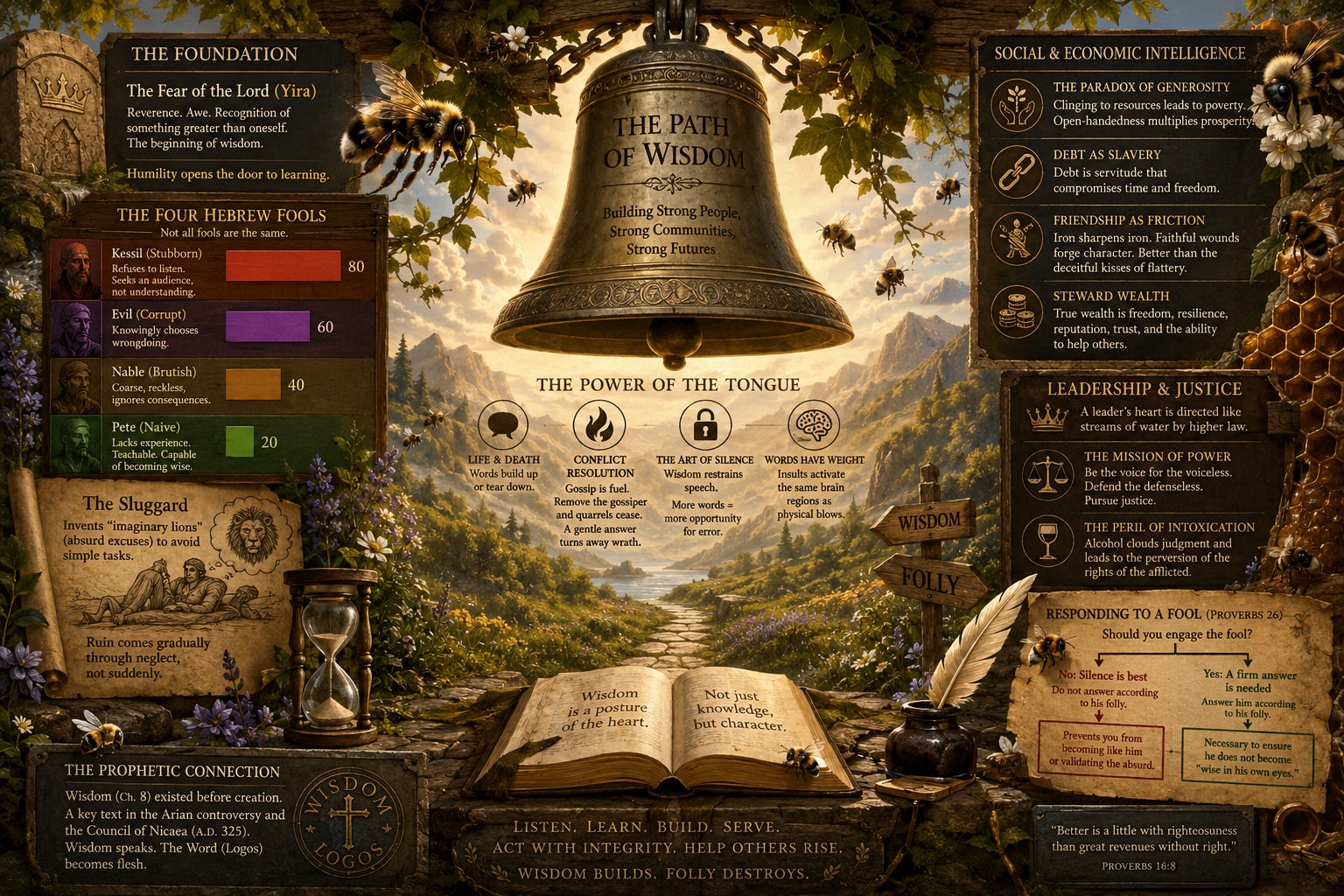
The Four Faces of Folly
One of the remarkable features of Proverbs is that it recognises different forms of foolishness.
Not all fools are the same.
The Naive Fool (Pete)
The naive person simply lacks experience.
They are not malicious.
They have not yet learned.
This person remains teachable and therefore remains capable of becoming wise.
Many people begin here.
The Stubborn Fool (Kessil)
This individual rejects correction.
They do not seek understanding.
They seek validation.
Their opinions become more important than truth.
They are often intelligent but lack wisdom because they refuse to listen.
Their greatest weakness is intellectual pride.
The Brutish Fool (Nabal)
This form of folly is coarse, reckless, and destructive.
The brutish fool ignores consequences.
Impulse governs action.
Emotion governs judgement.
Such individuals often damage themselves and others through carelessness.
The Corrupt Fool (Evil)
The highest form of folly is moral corruption.
This person knowingly chooses wrongdoing.
Their actions become harmful not through ignorance but through intent.
While the naive fool may be taught, the corrupt fool often resists transformation because corruption serves their interests.
The Lesson of the Sluggard
Perhaps the most amusing figure in Proverbs is the sluggard.
The sluggard is not lazy because they cannot work.
The sluggard is lazy because they continually invent reasons not to begin.
“There is a lion in the road.”
“There is danger outside.”
“There will be a better time tomorrow.”
The lion rarely exists.
The excuse does.
Failure seldom arrives suddenly.
It arrives gradually.
One missed opportunity.
One neglected responsibility.
One postponed task.
Then another.
And another.
The sluggard’s downfall is not catastrophe.
It is accumulation.
Success and failure are often the result of repeated daily decisions rather than dramatic events.
The Power of Words
Ancient wisdom recognised something modern science continues to confirm.
Words possess power.
Relationships are built through words.
Trust is built through words.
Communities are built through words.
Wars begin through words.
Proverbs teaches that the tongue holds the power of life and death.
A gentle answer turns away wrath.
Harsh words inflame conflict.
Truth strengthens trust.
Deception destroys it.
Gossip is compared to fuel placed upon a fire.
Remove the fuel and the fire eventually dies.
Remove the gossip and many disputes disappear.
Those who constantly create division often do so through speech rather than action.
Wisdom therefore requires restraint.
The Discipline of Silence
One of the most overlooked teachings in Proverbs concerns silence.
The more words spoken, the greater the opportunity for error.
Wise people do not speak because they must fill silence.
They speak because they have something worth saying.
Silence creates space for observation.
Observation creates understanding.
Understanding produces better judgement.
Not every criticism requires a response.
Not every argument deserves engagement.
Sometimes the strongest position is restraint.
Wealth, Generosity, and Freedom
Modern culture often teaches accumulation.
Proverbs teaches stewardship.
There is a paradox repeated throughout the text.
Those who cling desperately to everything often lose more.
Those who give wisely often gain more.
Generosity creates relationships.
Relationships create opportunities.
Opportunities create prosperity.
True wealth is not measured solely by possessions.
It is measured by freedom, resilience, reputation, trust, and the ability to help others.
Debt and Dependency
Proverbs repeatedly warns about debt.
The borrower becomes servant to the lender.
This warning is not merely financial.
Debt often transfers control.
The greater the dependency, the less freedom remains.
A wise person therefore seeks to build stability, resilience, and independence wherever possible.
Freedom requires responsibility.
Responsibility requires discipline.
Discipline requires wisdom.
The Forge of Friendship
Many people define friendship as agreement.
Proverbs defines friendship differently.
“Iron sharpens iron.”
Real friendship includes honesty.
Real friendship includes challenge.
Real friendship includes correction.
A friend who always flatters may not be a friend at all.
The wounds of a faithful friend are often more valuable than the kisses of a deceiver.
Growth requires friction.
Without friction, blades remain dull.
Without challenge, character remains weak.
Leadership and Stewardship
The purpose of leadership is not power.
The purpose of leadership is responsibility.
A leader exists to serve something greater than themselves.
Power without wisdom becomes tyranny.
Power without justice becomes corruption.
Power without humility becomes arrogance.
The highest duty of leadership is to protect those who cannot protect themselves and to give voice to those who are not being heard.
The measure of leadership is not how many people serve the leader.
The measure of leadership is how many people are strengthened through their service.
Choosing When to Engage
One of the most sophisticated teachings in Proverbs concerns conflict.
At first glance it appears contradictory.
Do not answer a fool according to his folly.
Answer a fool according to his folly.
The wisdom lies in discernment.
Some arguments merely feed chaos.
Engaging them grants legitimacy.
Other situations require challenge because silence would allow falsehood to flourish.
Wisdom is knowing which circumstance stands before you.
Not every battle should be fought.
Not every battle should be avoided.
Discernment determines the difference.
Building Strong Communities
Every society reflects the character of its people.
Communities built upon deception eventually collapse.
Communities built upon greed eventually fracture.
Communities built upon arrogance eventually become unstable.
But communities built upon honesty, responsibility, humility, cooperation, stewardship, and mutual support create resilience.
The future belongs not merely to the strongest.
The future belongs to those who cultivate wisdom.
The path of wisdom is not complicated.
Listen more than you speak.
Learn more than you assume.
Build more than you criticise.
Serve more than you demand.
Correct with kindness.
Lead with humility.
Act with integrity.
Keep your word.
Take responsibility.
Help others rise.
These principles have guided people for thousands of years because they reflect something fundamental about human nature.
Strong people create strong families.
Strong families create strong communities.
Strong communities create strong futures.
Wisdom remains the bridge between where we are and what we may yet become.
A framework for building strong communities
Passing Wisdom Forward
Knowledge that remains hidden benefits only the individual.
Knowledge that is shared benefits the community.
Throughout history, wisdom has travelled from person to person, family to family, generation to generation. Every lesson learned, every mistake avoided, and every truth discovered becomes more valuable when it is passed on to others.
If these principles resonate with you, do not allow them to stop with you.
Share them.
Discuss them.
Teach them.
Help others discover them.
Strong communities are built when individuals become active participants in the growth of others.
The hive thrives because every bee contributes.
The bell rings because someone chooses to sound it.
The future improves when ordinary people share extraordinary ideas.
If you found value in this article, please consider:
• Restacking and sharing it with others.
• Inviting friends, family, and colleagues into the conversation.
• Subscribing to MJ’s The Right Stuff.
The Right Stuff is the lobby where people gather, learn, exchange ideas, and prepare for what comes next.
This is where conversations begin.
This is where connections are made.
This is where strong communities are built.
The bell is ringing.
The question is not whether the future will arrive.
The question is what kind of future we will build together.
Strong Communities Create Strong Futures.
— MJ 🐝
An inspiring amount of true wisdom in this post. Something that many could benefit highly from reading.
That is thinking proactively but now it needs to be put into a more digestible format which can be organized. ‘They’ know all this too but are way more proactive and way more organized. Also explain why going back to religion won’t just end up again at this point. That is to say, what is the new variable we missed before that needs implementing.